7 Signs That “Just a Stuffy Head” May Be Sinus Pressure
And the one word in a 40-year nurse’s handwritten note that changed how I respond to it

Forty years of nursing, one line of advice.
My grandma was a nurse for 40 years.
When she left me a handwritten note about sinus pressure, I expected the kind of long explanation only a nurse could give: a list of symptoms, a complicated routine, maybe a warning I would have to read three times.
Instead, she wrote one simple instruction:
When you feel sinus pressure starting, put this on IMMEDIATELY.
At first, the word that caught my attention was heat.
But the word that stayed in my head was immediately.
Why would the timing matter so much? And why did I keep waiting until the heavy, blocked feeling had already taken over my face before doing anything about it?
I did not understand the answer until I stopped treating every “stuffy head” as the same thing.
Because the first surprise is this: sinus pressure does not always announce itself the way people expect.
Sometimes it begins with clues so ordinary that they are easy to dismiss.
And the seventh clue is the one most people recognize only after it has already rearranged their day.
 Restora Eyes Open — heated sinus mask4.5 ★ · 1,091 verified reviews · Free US shipping
Check Availability →
Clue 1The discomfort keeps returning to the same part of your face
A general headache can feel as if it is everywhere.
Sinus-area pressure often feels more specific: around the forehead, between or around the eyes, beside the nose, through the cheeks, or in more than one of those places at once.

Forehead, between the eyes, beside the nose, through the cheeks — the same few places, again and again.
It may feel dull instead of sharp. Heavy instead of dramatic. More like something is pressing outward than something is striking inward.
That makes it easy to minimize.
You may still answer messages. You may still finish the task in front of you. You may simply rub the same place on your face, tell yourself you are tired, and keep going.
But location is only the first clue.
The second is the word people use when “pain” does not quite describe it.
Clue 2You call it fullness because “pain” feels like the wrong word
Many people describe sinus discomfort as pressure, fullness, heaviness, or a blocked feeling.
That distinction matters because pain gets attention. Fullness often does not.
Fullness sounds tolerable. Temporary. Like something you should be able to ignore until it passes.
So you wait.
Then the sensation becomes harder to separate from everything else: the congestion, the headache, the difficulty concentrating, the sense that your face feels tired before the rest of you does.
According to ENT Health, facial pain or pressure, nasal obstruction, and nasal drainage can be part of a sinusitis symptom pattern. But facial pressure alone does not identify the cause, which is why persistent or unusual symptoms deserve proper evaluation.1
That brings us to the third clue—the one that turns an annoying sensation into a repeating pattern.
Clue 3Congestion and pressure seem to arrive as a pair
You notice the stuffiness first.
Then the forehead feels heavier.
Or the pressure arrives first, followed by the feeling that your nose and face are no longer working as freely as they did an hour earlier.
The order may change. The pairing is what stands out.
When the tissues lining the nose and sinus openings become swollen, normal airflow and drainage can be affected. That can contribute to the blocked, pressurized feeling people associate with sinus trouble.1
This does not mean every headache, toothache, episode of facial pain, or case of ringing ears is caused by the sinuses. Migraine, allergies, dental problems, and other conditions can overlap with the same area.
But when fullness and congestion keep appearing together, the pattern is worth noticing.
Especially if the fourth clue has already become part of your routine.
Clue 4A hot shower or warm towel feels surprisingly comforting
Maybe you stand in the shower longer than you intended.
Maybe you press a warm washcloth across your forehead and nose.

Your body has already shown you the kind of comfort it wants.
Maybe you have never thought of that as a “sinus routine.” You only know that warmth feels good when your face feels tight, heavy, or blocked.
That instinct is not unusual. Mayo Clinic includes a warm compress on the nose and forehead among self-care measures that might help lessen sinus pressure.2
The important word is might. Warmth is a comfort measure, not an explanation for every symptom and not a replacement for appropriate care.
Still, the moment warmth feels soothing tells you something useful: your body has shown you the kind of comfort it wants.
Unfortunately, it has not shown you how to make that comfort last.
That is where clue five appears.
Clue 5The relief ends when the towel cools
A washcloth is simple.
It is also temporary.
You warm it, sit down, position it across your face, and begin to relax. Then the temperature fades. You get up, return to the sink, warm it again, and restart the process.
A microwave pack lasts longer, but it creates its own interruption. It must be heated, checked, carried back, and heated again when it cools.
The problem is not that these methods are useless. The problem is that the routine asks you to keep interrupting the very moment in which you are trying to settle down.
And once the ritual becomes inconvenient, most people become less consistent with it.
That is why clue six is less about your sinuses and more about your behavior.
Clue 6You keep collecting remedies, but none becomes a routine
There is the spray in the bathroom.
The washcloth by the sink.
The microwave pack in a drawer.
The hot shower you take when the pressure becomes impossible to ignore.
The search history full of questions you meant to investigate later.
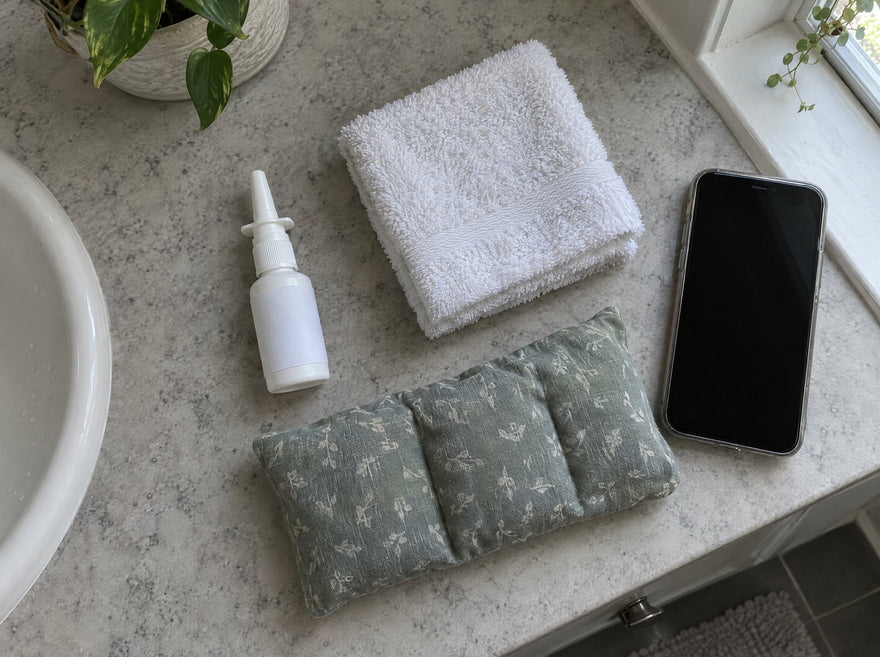
Every tool solves one part of the experience. None of them becomes the routine.
The collection grows because every tool solves one part of the experience. One is convenient but brief. Another feels good but covers your eyes. Another requires a trip to the kitchen. Another belongs to a completely different part of your care plan.
You do not necessarily need more options.
You need to understand which job each option is meant to do—and which one you can realistically use when the first signs appear.
That returns us to Grandma’s note.
And to the seventh clue.
Clue 7You wait until the pressure is bad enough to “deserve” your attention
This is the easiest clue to miss because it feels reasonable.
You do not want to stop what you are doing for something that might pass.
You do not want to begin a whole routine over a little heaviness near your forehead.
You wait for certainty.
But certainty usually arrives in the form of stronger discomfort.
By then, you are no longer choosing a small comfort break. You are reacting to a feeling that has already claimed your attention.
That was the point of the word Grandma underlined without actually drawing a line beneath it:
IMMEDIATELY.
Not because warmth diagnoses the problem.
Not because every uncomfortable feeling has the same cause.
Because a simple comfort ritual is easier to use when it is ready before you are desperate for it.

Ready before you need it. That was the whole instruction.
Once I understood that, the real problem with my old warm-compress routine became obvious.
It was not the warmth.
It was everything required to keep the warmth going.
The UpdateThe part of Grandma’s advice that needed an update
Grandma trusted heat.
I trusted it too.
What I did not trust was myself to stand at the sink reheating a towel every few minutes.
That is why the Restora Heated Sinus Mask made sense to me.
It takes the familiar idea of a warm compress and turns it into a repeatable session:
The session
- Position the mask across the forehead and sinus area.
- Choose one of three warmth levels.
- Select one of five timer settings.
- Sit back while the mask maintains powered warmth through the session.
 Three levels · five timers
 Eyes open
Set it once. Stay in the room.
The eye openings mean you are not automatically cut off from the room around you. You can remain seated with a book, a television program, or a quiet part of your day instead of holding a towel in place.
And because the warmth comes from the mask, there is no return trip to the sink or microwave halfway through.
That practical difference may sound small.
Until you realize that small inconveniences are often the reason a helpful ritual never becomes a real routine.
The PointWarmth is not the mystery. Consistency is.
The most useful part of Grandma’s note was not a secret ingredient or a complicated theory.
It was permission to notice the first signal and respond with something simple.
Restora does not ask you to learn an unfamiliar ritual. It makes a familiar one easier to repeat.
And that creates the next question:
What exactly makes a powered heated mask different from the warm towel you already own?
The answer is not merely “it gets warm.” It is in the coverage, controls, timer, and the way those pieces change the experience of the session.

See the complete Restora routine
Explore the warmth settings, timer options, coverage, care instructions, and answers to the questions people ask before choosing a heated sinus mask.
Check Availability →✓Free US shipping✓60-day money-back guarantee
Please ReadA brief note about symptoms
Sinus-area pressure can overlap with migraine, allergies, dental pain, eye problems, and other conditions. Seek medical advice for severe, worsening, persistent, unusual, or recurring symptoms, or when you are uncertain about their cause. Restora is a facial-warmth product and does not replace diagnosis or prescribed treatment.
Sources
Wellness product, not a medical device. Start on low heat for 10–15 minutes. If you have an eye condition, are pregnant, or have diabetes, circulation or skin issues, check with your doctor first. This article is general information, not medical advice, and does not diagnose or treat any condition.
