Your Hearing Test Was Normal. The Ringing Is Still There. Here Is the Part Nobody Measured.
A clear audiogram rules out the inner ear. It does not rule out the narrow passage sitting just behind it — and that passage answers to the pressure in your face.


Twenty minutes of steady warmth across the sinuses, temple to temple — with the evening still running.
You did the sensible thing. You booked the hearing test. You sat in the booth, pressed the button for every tone you caught, and waited for an answer that would explain the sound you have been living with.
The answer was that your hearing is fine.
Which is good news, and no help at all. Because the ringing did not stop when the result came back. It is still there in the quiet part of the evening, still there when you lie down, and it is still doing the thing you have probably stopped mentioning to anyone — it comes and goes with the pressure in your face.
That pattern is the whole article. If your ringing rises when your head feels full and eases when it clears, the test that came back normal was measuring the wrong part of your ear.
The PressureWhat is actually happening behind your face
The sinuses are four pairs of air-filled cavities in the bones of the face. Each is lined with a thin membrane, and each drains through a narrow opening into the nose.
When that lining swells — from a cold, an allergy, dry indoor air, an irritant — the openings narrow. Mucus thickens and stops draining. Pressure inside the cavity rises. That is the ache behind the cheekbones and brow, the fullness between the eyes, and the tenderness that can reach the upper teeth.
Nothing about this is exotic. It is the most ordinary problem in the face. What is unusual is how rarely anyone follows it one inch further back — into the ear.

Four zones, one connected system. The pressure does not stay politely inside the cavity it started in.
The ConnectionThe tube nobody tested
The middle ear is joined to the back of the nose by the Eustachian tube — a narrow passage whose only job is to keep the pressure behind your eardrum equal to the pressure outside it.
The same swelling that blocks a sinus opening can block that tube. When it does, pressure in the middle ear drifts, the eardrum stiffens, and the ear reports it the only way it can: fullness, muffled sound, popping — and often a ringing or humming tone with no injury behind it at all.
The mechanism
Swelling narrows two things at once. The sinus opening, which you feel as pressure. And the Eustachian tube, which you hear.
The ear is not damaged. It is reporting a pressure problem. Clinicians call it Eustachian tube dysfunction.
So the ringing tracks the congestion. Worse with a cold, an allergy season, a flight, a dry room. Better when the face clears.

Where the warmth actually lands — across the frontal and maxillary sinuses and both temples.
The Blind SpotThree reasons this gets missed
A standard hearing test does not measure it. An audiogram measures how well the inner ear and auditory nerve detect sound at each pitch. Middle-ear pressure is a different measurement, taken with a different instrument, and it is not always part of a routine screening.
The usual suspects show up on that test. The two most common sources of ringing — age-related and noise-related hearing loss — are both visible on an audiogram. When the audiogram is normal, the conversation often ends there.
It comes and goes. Ringing that comes from sinus pressure is not constant. On the morning of the appointment it may not be present at all.
The pattern to notice is ringing that tracks your sinuses: worse when the face feels full, better when it clears, usually in both ears, and arriving with a sense of pressure rather than any loss of hearing.
The LeverWhat warmth actually does
Warmth held over the sinuses does four things, each well described in the literature on local heat therapy.
It opens circulation through the lining. Blood vessels in warmed tissue widen, moving more blood through the swollen membrane and helping it settle.
It thins mucus. Mucus loses viscosity as it warms, so it drains through the narrowed openings instead of collecting behind them. Moist heat does this better than dry, because the moisture reaches the lining directly.
It releases the guarding tension. Pressure in the face sets off a bracing across the brow and temples. Steady warmth relaxes it — which is why the ache often eases before the congestion does.
It quiets the pain signal. Warmth receptors in the skin compete with pain signals from the same region, so less of the pressure registers while the heat is on.
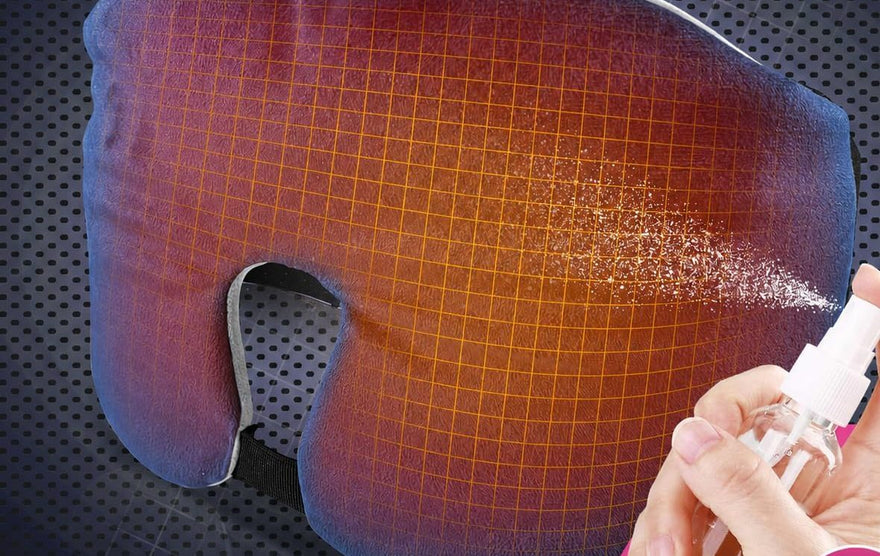
A few sprays before the session. The element warms the water, and the water carries the heat to the lining.
The CatchIt has to last longer than you think
Here is the part that undoes almost every home remedy. Tissue warms slowly. It takes several minutes just to bring the skin and the bone beneath it to temperature, and the effects above build across a session of fifteen to twenty minutes.
The weakness of the usual methods was never the heat. It was the clock.
A hot towel is genuinely warm for about two minutes. A microwaved pack comes out too hot to hold against your face, then falls to lukewarm before the session is half over. Neither one holds moderate, steady warmth for long enough to matter.
 Warm for 2 minutes
 Steady for 20
The towel is not wrong. It is just finished before the tissue has started.
Twenty steady minutes, every evening
A controlled element brings the fabric to temperature, holds it there for the whole session, and switches off on its own.
See the Eyes Open mask →✓Free US shipping✓60-day money back✓Ships in 1–2 days
The MaskWhat we built for this exact problem
Restora Eyes Open is an extra-large heated sinus mask. The element covers the frontal and maxillary sinuses and both temples — four inches by eleven, temple to temple. Three heat levels, five timers, an LED controller, and a mist bottle for moist heat.
The cut-outs are the part people mention most. A twenty-minute session does not have to end your evening — you can read, watch, or keep working straight through it.

Restora Eyes Open — heated sinus mask
★★★★★ 4.5 · 1,091 verified reviewsMoist or dry heat across the sinuses and temples. Holds temperature for the full session, then switches itself off. Machine washable. Sixty days to send it back, prepaid label, no forms.
See it →Verified BuyersWhat people actually report

Most people who buy this have already tried the towel, the pack, the rinse and the spray.
I have suffered for years with a deviated septum. After wearing it for about 20 minutes, when I went to use my nasal flush it was like the world opened up to me. Everything came out and I can breathe again.
A. WilsonI bought it over the winter when my sinuses were really bothering me, and it made such a difference. The gentle heat feels amazing on your face and provides real, noticeable relief.
Verified buyerI got this because I'm having chronic sinus pressure and headaches and I need to be able to function during the day. It fits well and the heat is well distributed through the nose.
Verified buyerIt is wonderful. The sinus pressure pain is gone.
Verified buyerCommon QuestionsThe three we get most
My doctor never mentioned my sinuses when I asked about the ringing.
Most likely because the test that was run does not look there. An audiogram is a hearing measurement, not a pressure measurement. If your ringing moves with your congestion, that pattern is worth raising specifically — it points at a different instrument.
I already own a microwavable mask. Why would I need another one?
Because the problem was never the first two minutes. A microwaved pack starts too hot and is lukewarm by minute eight. The difference here is duration at a controlled temperature, not more heat.
Is this going to cure my tinnitus?
No, and anyone promising that is selling you something. Heat works on swelling. If your ringing is driven by pressure, easing the pressure is a direct lever. If it comes from the inner ear or the auditory nerve, heat will not reach it — and the next section is for you.
Before You DecideWhere this stops
If your ringing moves with your sinus pressure, the most direct lever is the pressure itself. Steady heat across the sinuses, held at temperature for a full session, works on the swelling that narrows both the sinus openings and the Eustachian tube — and it can be done at home every evening.
But heat will not reach ringing that comes from the inner ear or the auditory nerve.
And it is not a substitute for an examination when the ringing is constant, confined to one ear, pulses in time with your heartbeat, or arrives alongside sudden hearing loss or dizziness. Those belong with a clinician, promptly.
Twenty minutes. Eyes open. Every evening.
The Restora Eyes Open heated sinus mask — built for the people who already tried the towel.
See the mask →✓Free US shipping ✓60-day money-back guarantee ✓Ships from a US warehouse
Wellness product, not a medical device. Start on low heat for 10–15 minutes. If you have an eye condition, are pregnant, or have diabetes, circulation or skin issues, check with your doctor first. This article is general information, not medical advice, and does not diagnose or treat any condition.